This section contains miscellaneous writings from people in our church, or from authors in the past whose books relate to a topic of truth that is relevant for today.
Books
Non-Violent Coercion
How the Gospel Came to Britain
A Living Experience with God
A Song in the Night
Exporations in Present Truth
Booklets
The Principles of Reform
From Thornbush to Apple Tree
Two Things Called by the Same Name
Articles by Bill Race
Non-Violent Coercion
 Here is a book I came across while searching on the topic. It was published in 1923 by a Sociology professor in America, and is a study into the use of non-violent coercion, or “soul force” as Gandhi liked to call it.
It covers some of the history of various Anabaptist groups and other small denominations who held to this truth because they strongly believed in the separation of church (the power of spiritual love) and the state (the power of carnal force); or “the garden of God,” and “the wilderness of the world,” as Roger Williams phrased it.
It also covers the use of this principle of non-violent non-cooperation in other facets of society. Of course, this is not a religous book, nor a book of faith; although you can certainly be inspired by studying it. In some places the language is scholastic (dense) and not everyone will be able to wade through it.
The importance of this study is highlighted by the book Behold Your God, in which God’s non-violent character is explained all throughout the Bible. The book, The Seven Angels, also shows how the 144,000 will triumph, just as Jesus triumphed on the cross, which was the ultimate expression of non-violent love. It is this revelation of God’s character that will bring down the kingdom of Satan. 391p


How the Gospel Came to Britain
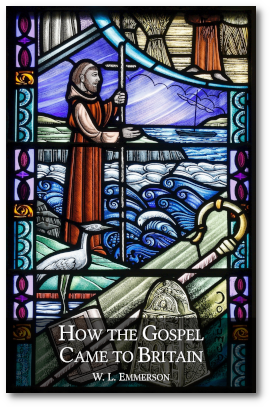 There was an ancient church in Britain, established around the time of the Apostles.
For hundreds of years this church grew and developed, and sent missionaries throughout the Ireland and the British Isles, and further into Western Europe.
Eventually, the church of Rome, unable to endure a Christian group that was not under her direct authority, moved to subdue this ancient branch of Christianity.
This booklet outlines some details of this interesting history. There are lessons in it for us today. 60p
Contents
- Did Rome Convert Britain
- Britain’s First Evangelists
- Persecuted Yet Triumphant
- How Ireland and Scotland Were Evangelized
- The First Clash With Rome
- Did Rome Convert the Saxons?
- How Britain Preserved the Ancient Faith – I
- How Britain Preserved the Ancient Faith – II
- The Eclipse of the Early British Church
The Principles of Reform
 In the past, many people who wanted to be faithful to God have often seen the need to practice reform in their daily lives in order to prepare for heaven. Their goal was to bring their eating, drinking, clothing, contact with others, and so forth, into obedience to Christ. They viewed their task as a privilege and took up their work joyfully.
Unfortunately, reform has often been seen as a burden by professing Christians. And many people today feel that it is a limitation on their natural wishes and tendencies, an unnecessary burden of the law, and an unwelcome intruder.
But do we understand what reform really means? What is its purpose, and how does it apply to our lives? These questions need to be answered so that, as believers, we can render intelligent service to God.
This book gives a basic introduction into the principles behind practical changes in life habits, and how they fit in with the gospel plan of uplifting mankind. 83p
A Living Experience with God
 The time we live in today is remarkable for its superficiality–seldom has it been as widespread as it is now. Masses of people simply exist from one day to the next throughout their lives without ever really getting to the bottom of anything. Although it is true that some people are accomplishing amazing things, there is a trend to shallowness with many that pervades all areas of life.
Are you someone who’s looking for a fulfilling, rewarding life? Do you want more than what a shallow inconsequential lifestyle has to offer? Are you looking for more than clichéd phrases in answer to your questions?
Are you fed up with being put off with empty consolations and soothing words when you ask about the deeper meaning of life? If so, then this booklet has been written just for you!
The goal of this booklet is to lead you to a profound and living experience with Jesus Christ. 193p
The SDA Bible Commentary, vol. 7, p. 907The soul that loves God, rises above the fog of doubt; he gains a bright, broad, deep, living experience.
From Thornbush to Apple Tree
 From Thornbush to Apple Tree is a book about the basic gospel message written for children. Each page has an illustration by a child, with a lesson underneath.
When the Jewish leader Nicodemus wanted to know about the kingdom that Jesus was establishing, and how it would look, Jesus said, “except a man be born again he cannot see the kingdom of God.” (John 3:3)
Therefore, the new birth is an essential element in the proper understanding of prophecy. Only those in whom Christ’s spiritual life is reproduced can really understand, appreciate, and work toward the building of Christ’s kingdom.
This book introduces the topic in a way that children can understand it. 24p
A Song in the Night
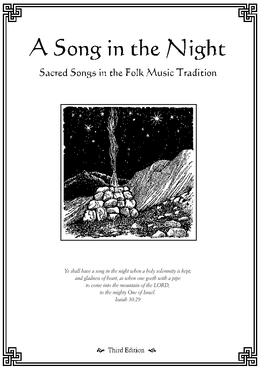 The songs in this collection are a combination of folk, or folk-style melodies, and Biblical poetry. This type of union has been practiced at least since the days of the Protestant Reformation, and possibly much earlier. It is illustrative of the gospel, in which God takes common humanity, with its personality, feelings, and modes of expression, sanctifies it, and fills it with a new life, inspiring it with a fresh, and more meaningful message to give to the world, and to the on-looking universe.
“A Song in the Night” continues and extends this tradition by combining other folk melodies, such as those from the Canadian provinces of Nova Scotia and Quebec, with suitable religious poems. The results have been very satisfying, and have yielded what many think to be the best songs in the entire collection.
Asides from these original contributions, much of the material has been drawn from previous collections, especially those of the early American period (late 1700 ‘s to mid 1800 ‘s), such as the Sacred Harp and Christian Harmony. It was during this period that the church, during the great Second Advent Awakening, reached it’s purest and most powerful state, in striving to prepare for Christ’s imminent return. Since it remains for the church or our day to take up where they left off, and carry the work to completion, this seemed like a good starting point from which to draw the larger part of the inspiration of this current work. As well, songs have been drawn from earlier revivals, including the Reformation of the 16th and 17th centuries, and the Wesleyan revival during the 1700 ‘s in England.
In choosing the Biblical poetry that is used for the lyrics of the songs, the highest standard has been our aim. These words can stand on their own as great poetry. They have an uncommon depth, and cover the full range of experiences that face everyone who names the name of Christ, and takes up his cross after Him. It is not surprising that you will often find the names of Isaac Watts, the Wesleys, Wilson MacDonald, and others, who possessed the gift of poetical expression in no common manner, and who matched this with true Christian piety and devotion. Their work endures because the Spirit of the Everlasting One is in it, and thereby they “being dead, yet speak” to us today.
These songs, with their earnest feeling and intelligent expression of faith, will assist in bringing the Word of God into your daily life, where it belongs. 126p
You can view pictures of sample pages of the book here: Sample Pages. There are also more music resources available on my poetry website: Practica Poetica
Explorations in Present Truth
 For about 10 years (1968-1978), Wolfgang Meyer served as a minister in the European field.
He contributed numerous articles to the Messenger magazine, and authored one booklet. His studies were strictly within the realm of the present truths that God was revealing to His people, which was not a restriction to him, but rather a springboard into before-unimagined realms of spiritual thought and grace. The limitations of God, he found to be much greater than the supposed “freedoms” of man.
There are 11 published articles included in this collection, along with Wolfgang’s published booklet, The Man of Sin in contrast to The Man of Righteousness. The Appendix contains a few articles related to Wolfgang’s unexpected death in 1978, and the lessons learned from it. 272p
Contents
- What is Justification by Faith?
- The Voice in the Wilderness
- Principles of the Judgment
- Flee
- Flee the Church?
- God’s Vengeance in the Trumpets and Plagues
- Too Late!
- Holy Anger
- Do We Destroy?
- Contradictions and New Light
- The Gospel of the Kingdom
- The Law of Cohesion and the Cross
- The Man of Sin in contrast to The Man of Righteousness
Two Things Called by the Same Name
 This booklet collects together a number of Scriptural distinctions that were made in the truths taught by the Sabbath Rest Advent Church, as those truths developed.
Just as the early Christians learned that there were two “comings of Christ” (one in humility, one in power), and two “kingdoms” associated with those comings (the kingdom of grace and the kingdom of glory), so have we had to make other such distinctions in our understanding of the Bible, in order to gain a clearer and more complete picture of Bible truth.
Two natures (of man), two deaths, two crucifixions, two crosses, two justifications, two laws, two covenants…these are just some of the many distinctions that this book covers. It was written to provided “the gospel in a nutshell”, or the truth in a compact and concise form. 61p
Contents
- Introduction
- The Two Natures
- The Two Deaths
- The Two Crucifixions
- The Two Crosses
- The Two Justifications
- The Two Blotings Out of Sin
- The Two Marriages
- The Two Laws
- The Two Covenants
- The Two Propensities
- The Two Churches
- Perfectionism vs So-Called Perfectionism
- The Two Seals
- Conclusion
Articles by Bill Race
Brother Bill Race was a friend of Fred Wright, and fellow believer in the message, at least as early as 1962, when they were both involved in the Brinsmead Awakening. Fred described him at that time as “an excellent student of the Bible” (see A Brief History of the Early Years, p. 34). Brother Race celebrated his 50th wedding anniversary in 1973. At that time Fred wrote:
“Brother Race has been a real veteran in the unfolding of this message. He has been in it from the very beginning and has weathered with us its worst storms so far and has stood firmly for the truth in every crisis. At our camp meetings he has assisted in the meetings and has brought to light some very precious truths. The readers of The Messenger will have read with interest and enlightenment several studies as presented by him.” (News Review, May 1973)
There were, in fact, 7 articles published in his name, and they are all precious and worthy of republication. I have included them in the Articles section of this website, and include links to them here as a type of index:
- The Number 666 (April 1966) – PDF, ODT.
- His Name is Wonderful (June 1967) – PDF, ODT.
- The Illegitimate (April 1970) – PDF, ODT.
- The Tribe of Dan (July & August 1970) – PDF, ODT.
- His Brother’s Name (August & September 1971) – PDF, ODT.
- Peter’s Sword (April 1972) – PDF, ODT.
- Jehu the Foolish Virgin (November 1972) – PDF, ODT.